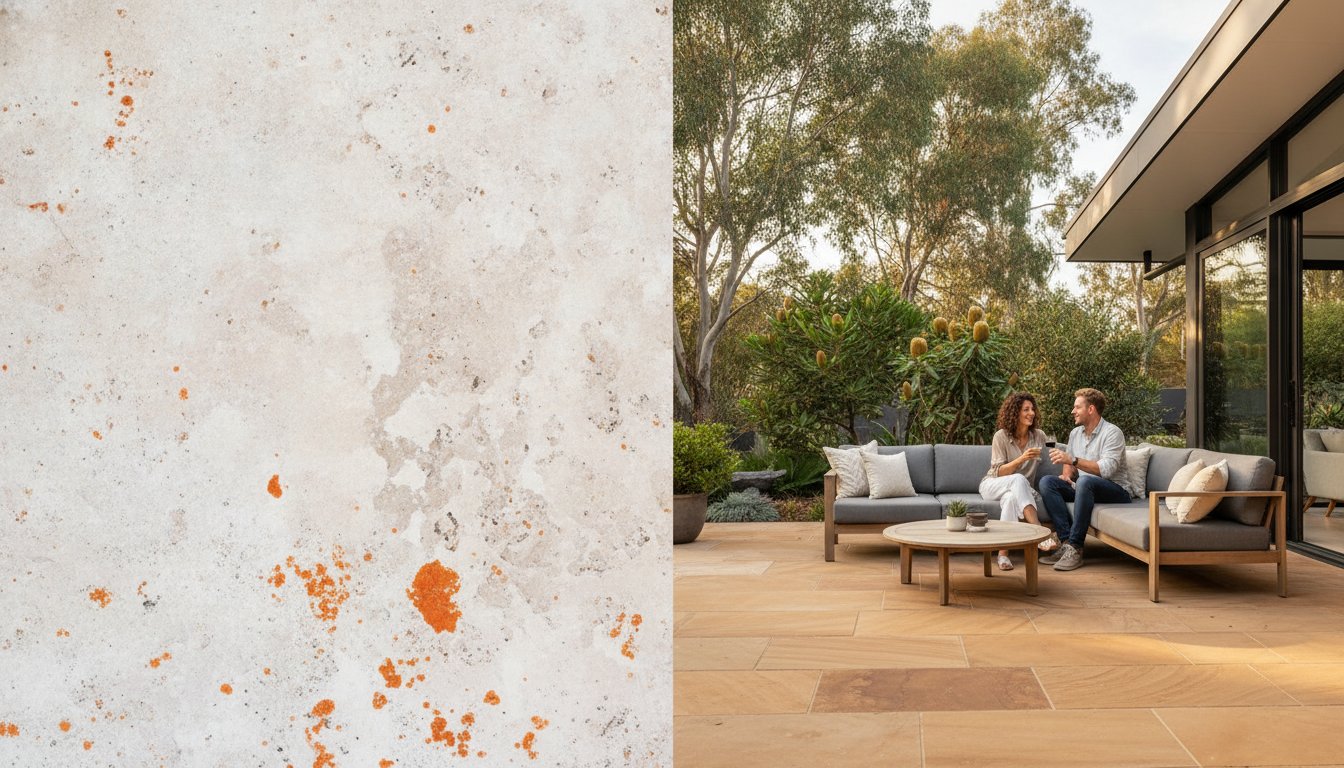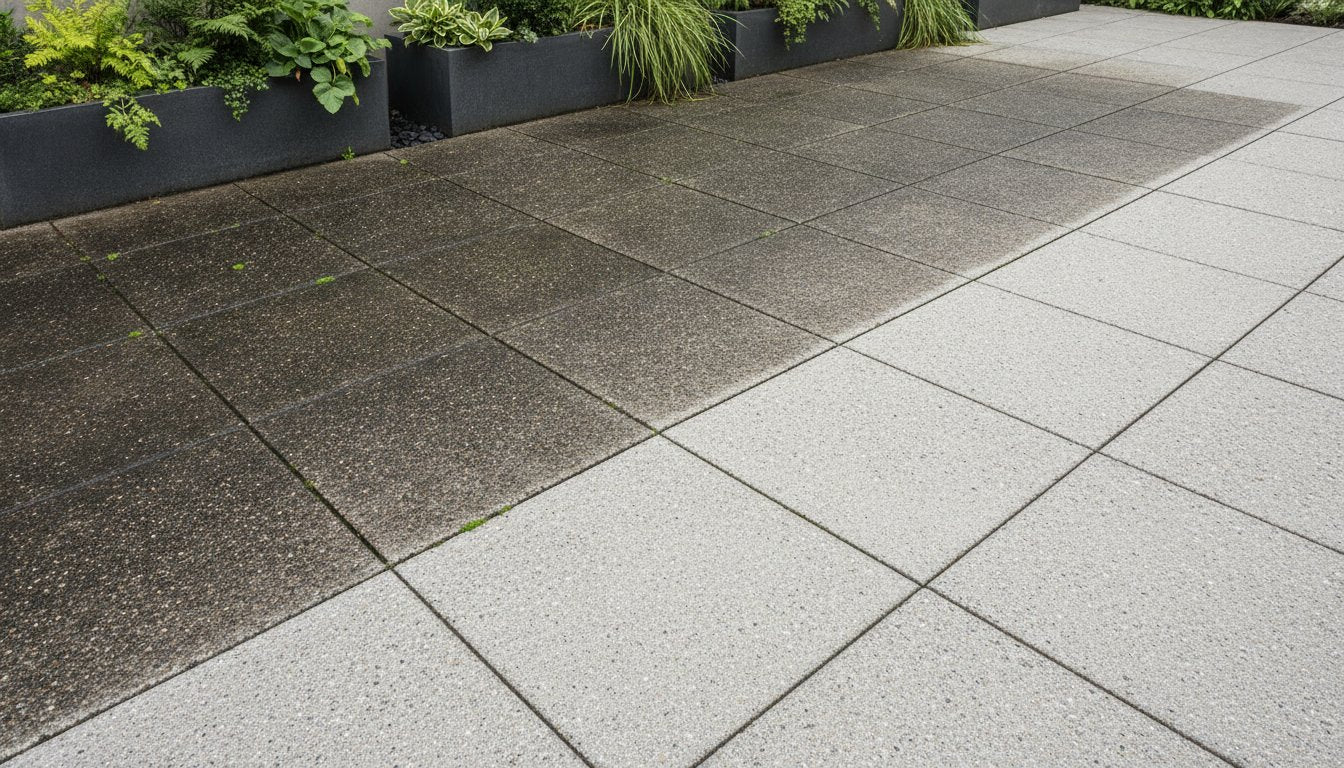
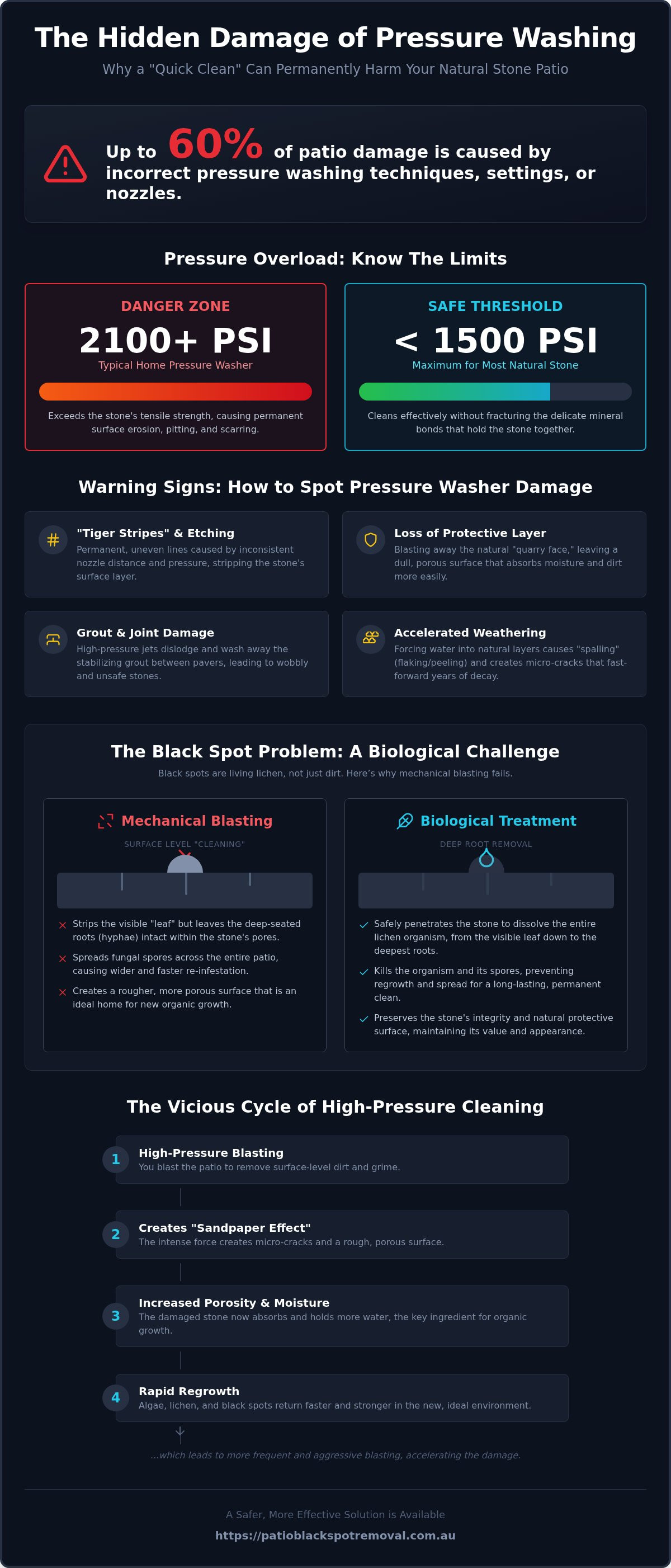
That high-pressure blast feels satisfying, but up to 60% of patio damage is actually caused by using the wrong pressure settings or nozzles. It's a common mistake to assume more power equals a better clean, yet understanding why using your Gerni on your patio can cause damage is the first step in protecting your expensive natural stone. While a typical home pressure washer like a Gerni 7000 can operate at over 2100 PSI, most natural stone surfaces shouldn't exceed 1500 PSI to avoid permanent surface erosion or etching.
You've likely spent hours trying to blast away those stubborn black spots, only to be left with visible "tiger stripes" or grout washing out of the joints. It's frustrating to realize that the more you blast, the more you might be stripping away protective layers and inviting future decay. In this article, you'll discover why high-pressure cleaning is often the enemy of your stone patio and how to remove lichen permanently without causing structural damage. We will explore the risks of mechanical blasting and introduce a non-invasive, biological approach that preserves your stone's value while making it look brand new again.
Key Takeaways
- Understand why using your Gerni on your patio can cause damage by exceeding the tensile strength of natural stone, leading to permanent erosion and pitting.
- Learn why high pressure only removes the visible part of black spots while leaving the deep-seated lichen roots to regrow and spread quickly.
- Discover how aggressive cleaning creates a "sandpaper effect" that makes stone more porous and prone to rapid moisture absorption.
- Identify the warning signs of pressure washer damage, including permanent "tiger stripes" and chalky surface scarring that can devalue your outdoor space.
- Explore the benefits of biological treatments that dissolve organic growth safely without the need for destructive mechanical blasting.
The Hidden Risks of High-Pressure Cleaning on Natural Stone
Many homeowners reach for their pressure washer the moment they see a stain, but they rarely consider the physics involved. The "Gerni effect" occurs when the concentrated force of water hits a surface at speeds high enough to exceed the stone's tensile strength. While concrete is engineered for durability, natural stone is a product of geological time, held together by mineral bonds that weren't designed to withstand a direct hit from 2300 PSI. Understanding why using your Gerni on your patio can cause damage begins with recognizing that you are essentially hitting your stone with a liquid hammer.
Concrete is a uniform, man-made mix, but natural stones like sandstone, limestone, and slate are sedimentary. They are formed in layers. When you apply high pressure, you aren't just washing the surface; you are often driving water between these layers. This leads to surface delamination, where the beautiful "quarry face" of the stone is blasted away, leaving behind a dull, uniform, and damaged finish. Surface scarring is the permanent removal of the stone's protective top layer.
Understanding the 'Water-Knife' Effect
A pressure washer doesn't just clean; it cuts. At high PSI, the water stream acts like a knife. Turbo nozzles are particularly dangerous because they use a rotating pinpoint jet that hammers the stone thousands of times per minute. This mechanical stress creates microscopic fissures in the surface. Even if you don't see the damage immediately, these tiny cracks become home to more dirt, algae, and moisture. Even "low pressure" settings on home machines can be enough to compromise the integrity of softer sedimentary stone.
Why Natural Stone is Vulnerable
Australian sandstone and travertine are prized for their unique aesthetics, but they are incredibly porous. In our local climate, these stones are subject to intense heat and moisture. High-pressure water forces its way into the natural veins and faults of the stone. This often causes "spalling," a process where the stone begins to flake or peel off in thin layers. It's a structural failure that no amount of cleaning can fix. This is a primary reason why using your Gerni on your patio can cause damage that persists long after the water has dried. By forcing water into the stone's internal structure, you're effectively accelerating its natural weathering process by decades in just a few minutes.
Mechanical vs. Biological: Why Black Spots Survive the Blast
You've seen them: those stubborn, ink-like splatters that refuse to budge no matter how close you hold the nozzle. These aren't just stains or dirt; they are living organisms. To understand why using your Gerni on your patio can cause damage, you have to look at the biology of what you're trying to remove. Black spots are actually a form of lichen, a complex symbiotic partnership between fungus and algae. While a high-pressure blast might strip away the visible "leaf" of the lichen, it rarely touches the biological foundation hidden within the stone.
Pressure washing is a mechanical solution to a biological problem. When you blast the surface, you're only removing the "head" of the organism. The roots, known as hyphae, remain safely tucked away inside the microscopic pores of your sandstone or limestone. Because you've just saturated the stone with water, you've essentially given those remaining roots the perfect environment to thrive. This is why the spots often return faster and appear darker within just a few months of a heavy cleaning session.
The Science of Lichen Growth
Lichen doesn't just sit on top of your patio. It anchors itself deep into the stone's surface to stay hydrated and protected. Mechanical force cannot reach these depths without destroying the stone itself. In the shade of an Australian backyard, moisture lingers in the pores long after the sun comes out. This trapped water fuels re-growth from the inside out. If you want to stop this cycle, exploring professional-grade biological treatments is the only way to address the root cause without the risks of high pressure.
Why Blasting Leads to Spore Dispersal
One of the most overlooked risks of high-pressure cleaning is the aerosolization of fungal spores. As the water hits the lichen at 2000 PSI, it shatters the organism into millions of microscopic pieces that become airborne. These spores are then carried by the mist and deposited across the rest of your patio, including areas that were previously clean. Cleaning without killing is just a relocation service for spores. These spores find easy refuge in the new micro-cracks and fissures created by the pressure washer's force. You aren't just failing to clean the patio; you're actively planting the seeds for a much larger infestation next season.
The Vicious Cycle of Porosity and Rapid Re-infestation
When you run your hand across a newly laid piece of sandstone, it feels relatively smooth and solid. After a few sessions with a high-pressure washer, that texture changes. It becomes abrasive and gritty to the touch. This is known as the "Sandpaper Effect." By blasting away the top layer of stone, you're essentially stripping the surface and exposing the softer, more porous interior. Understanding why using your Gerni on your patio can cause damage involves looking at how this increased porosity changes the way your stone interacts with the environment.
A damaged stone surface acts like a sponge. Instead of water beadng off or evaporating quickly, it's sucked deep into the newly created micro-fissures. This creates a permanent feedback loop. More pores mean more room for dirt, mud, and organic matter to settle. This debris provides the perfect nutrient base for lichen and algae. Because the stone stays damp for longer, the biological growth returns faster and more aggressively than before. You're then forced to wash the patio more frequently, which only worsens the surface erosion. It's a cycle that eventually leads to the structural failure of the stone.
Stripping the Protective Surface
Natural stone often possesses a "quarry face" or a natural crust that serves as a primary defense against the elements. This layer is much denser than the stone's core and helps with water shedding. When high pressure removes this crust, you lose that natural protection. An etched surface is far more prone to catching organic stains. Tannins from fallen leaves, bird droppings, and mud become embedded in the rough texture, making them nearly impossible to remove without even more aggressive cleaning. This is a key reason why using your Gerni on your patio can cause damage that's visible even when the lichen is gone.
Creating a Breeding Ground
The relationship between stone depth and lichen survival is simple: the deeper the moisture goes, the longer the organism can survive a dry spell. High-pressure cleaning creates "micro-pools" on the surface of the stone. These tiny depressions harbor moisture long after the rest of the patio has dried. In the humid Australian climate, especially during the wet seasons, these damp pockets become active breeding grounds. While you might save money on a DIY clean today, the long-term cost of frequent pressure washing is far higher than a one-time biological treatment. You aren't just cleaning the stone; you're unintentionally preparing it for the next infestation.
Warning Signs: How to Identify Pressure Washer Damage
Identifying the aftermath of a high-pressure session is often a sobering experience for homeowners. While the stone looks clean when wet, the drying process reveals structural changes that cannot be reversed. This is the moment many realize why using your Gerni on your patio can cause damage that far outweighs the benefit of a quick clean. From unsightly marks to loose slabs, the warning signs are usually clear if you know where to look. If you notice any of these symptoms, it's time to stop the mechanical blasting and consider a non-invasive stone restoration process.
Surface scarring is one of the most common issues, appearing as a chalky or "blown" texture on stones like slate or limestone that were previously smooth. You might also notice pitting, which occurs when high-pressure water (often exceeding 2000 PSI on modern Gerni models) blasts out the softer minerals within the stone. This leaves behind tiny holes that act as magnets for dirt and moisture, accelerating the decay cycle discussed in previous sections.
Spotting Tiger Stripes and Etching
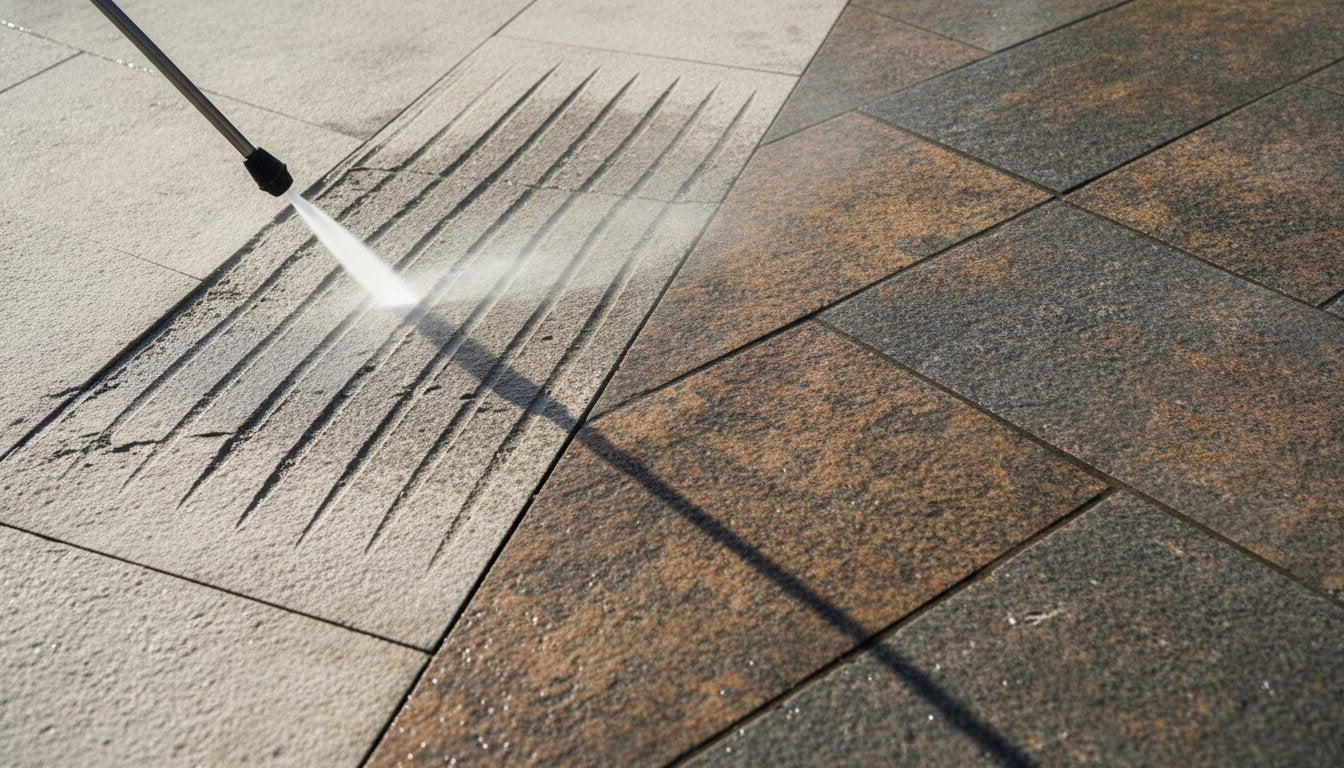
Many online forums incorrectly claim that "tiger stripes" are simply missed spots of dirt. In reality, these are often physical gouges in the stone's surface. You can tell the difference by running your fingernail across the line; if you feel a dip or a change in texture, the stone has been etched. These wand marks are caused by uneven movement or holding the nozzle too close to the surface. Because the "water-knife" has physically removed the stone's top layer, these marks are nearly impossible to sand out or hide, leaving a permanent record of the cleaning attempt across your entire patio area.
Jointing Failure and Structural Instability
The gaps between your patio slabs are just as vulnerable as the stone itself. Aiming a high-pressure stream at these joints is a recipe for disaster. This leads to several critical issues:
- Joint Erosion: The rapid loss of pointing mortar or stabilizing sand.
- Wobbly Stones: Without the support of the jointing material, slabs can shift, creating uneven surfaces.
- Trip Hazards: Loose stones are a primary cause of backyard accidents and can eventually crack under weight.
- Weed Infestation: Empty joints provide the perfect space for seeds to take root and flourish.
The cost of re-pointing a patio damaged by high pressure is significant, often requiring the professional removal of the remaining grout before new material can be applied. This structural instability is a major reason why using your Gerni on your patio can cause damage that affects the safety and longevity of your outdoor investment. Preserving the integrity of the joints is just as vital as protecting the face of the stone itself.
A Safer Alternative: Restoring Your Patio Without the Blast
Instead of relying on brute force, the modern approach to stone care focuses on biological eradication. The philosophy of "Treat, Don't Blast" recognizes that black spots are a living problem requiring a biological solution. Specialized stone restorers use targeted formulas designed to dissolve the lichen bond at a molecular level. This process effectively liquefies the organism, allowing it to be rinsed away gently without any aggressive scrubbing. By choosing this path, you eliminate the primary reason why using your Gerni on your patio can cause damage: the reliance on sheer mechanical force to solve a biological issue.
Low-pressure rinsing is the final step in this non-invasive restoration process. Unlike a Gerni, which uses a concentrated "water-knife" to cut into the surface, a low-pressure rinse simply clears away the dissolved organic matter. This preserves the "quarry face" and the natural density of the stone. It ensures that the protective surface remains intact, preventing the sandpaper effect and the rapid re-infestation cycle discussed earlier in this guide. Your stone stays smoother, cleaner, and structurally sound.
Biological Restoration vs. Mechanical Force
Biological treatments target the DNA of the black spot, ensuring the organism is truly dead rather than just relocated. Professional-grade removers are designed to penetrate the stone's pores to reach the roots without expanding the pores themselves. This professional application allows the formula to work over time, breaking down the complex symbiotic bond of the lichen. Because these treatments are specialized for stone types, they're far safer for your surrounding garden beds and environment than the high-pressure runoff and harsh industrial chemicals often used in DIY attempts. You get a deeper clean without the collateral damage to your lawn or prize roses.
Protecting Your Investment
Natural stone is a premium investment that adds substantial value to an Australian home. Maintaining it in its original condition is far more cost-effective than attempting to repair the permanent etching or joint erosion caused by improper cleaning. Transitioning from aggressive "cleaning" to a proactive "maintenance" mindset ensures your patio remains a highlight of your property for decades. Patio Black Spot Removal Australia serves as your partner in safe stone care, providing the expertise and specialized formulas needed to restore your patio without the risks of high pressure.
By understanding why using your Gerni on your patio can cause damage, you can make the switch to a method that prioritizes the long-term health and beauty of your outdoor living space. Professional restoration doesn't just remove spots; it preserves the integrity of the material, ensuring your expensive sandstone or slate looks as good as the day it was laid. It's about working with the stone's natural properties rather than fighting against them with high-pressure machinery.
Choose a Stone-Safe Future for Your Patio
High-pressure cleaning often provides a temporary illusion of cleanliness while masking permanent structural harm. By stripping away the stone's natural defenses and leaving deep lichen roots intact, mechanical blasting merely sets the stage for a darker, more aggressive return of organic growth. Understanding why using your Gerni on your patio can cause damage is essential for anyone looking to preserve the longevity and aesthetic of their outdoor living area. You don't have to risk "tiger stripes" or eroded joints to achieve a spotless finish.
As specialists in Australian natural stone, we provide a non-invasive restoration process that's safe for sandstone, limestone, and travertine. Our biological treatments dissolve the problem at the source, restoring your stone to its original quarry-fresh look without the need for aggressive force. It's the most effective way to protect your investment and maintain the value of your home.
Take the first step toward a beautiful, healthy patio today. Get a Free Quote for Professional Black Spot Removal and see how our specialized formulas can transform your space. Your stone deserves a treatment that respects its natural integrity.
Frequently Asked Questions
Can I ever use a pressure washer on my patio safely?
You can use a pressure washer safely on hard concrete surfaces if you maintain a setting between 2500 and 3000 PSI, but natural stone requires much more care. For delicate materials like sandstone or slate, the pressure should never exceed 1500 PSI. Using higher settings is a primary reason why using your Gerni on your patio can cause damage, as it often leads to surface etching that's impossible to reverse.
What are the black spots on my patio if they aren't just dirt?
Those stubborn black marks are actually lichen, a living organism formed by a symbiotic relationship between fungi and algae. Unlike surface dirt, lichen anchors itself deep into the microscopic pores of your stone. It's highly resistant to water alone and thrives in damp, shaded areas. This is why you can't simply wash them away; they require a biological treatment to dissolve the physical bond.
How do I fix 'tiger stripes' left by a Gerni?
Tiger stripes are usually permanent physical gouges in the stone surface, which makes them incredibly difficult to fix. Because the concentrated water stream has physically removed layers of the stone, these lines aren't just "missed spots" of dirt. In some cases, a professional stone restorer can use specialized treatments to help blend the surface appearance, but preventing this mechanical damage is always the best strategy.
Are the chemicals used in biological removal safe for my lawn?
Professional biological treatments are designed to be much safer for your garden than the aggressive runoff created by high-pressure cleaning. These formulas are specifically targeted at organic growths like lichen and don't require the massive volumes of water that spread contaminants. When applied by specialists, the process is non-invasive and protects the health of your surrounding lawn and garden beds.
Why do the black spots come back so quickly after I pressure wash?
Black spots return quickly because pressure washing only removes the visible part of the lichen while leaving the roots, or hyphae, protected inside the stone. The high-pressure water also saturates the stone's internal structure and aerosolizes microscopic spores, spreading them to new areas. This creates a perfect, damp breeding ground that allows the lichen to regrow even faster than it did before the clean.
Is it cheaper to DIY with a Gerni or hire a professional restorer?
A DIY session might seem cost-effective upfront, but the potential for expensive stone damage is high. Replacing etched sandstone slabs or re-pointing an entire patio after joint erosion costs significantly more than a professional treatment. Investing in a safe, biological restoration preserves the value of your natural stone and prevents the need for major structural repairs down the track.
How long does a biological patio treatment last?
A biological treatment typically keeps a patio clean for much longer than mechanical washing because it eradicates the organism entirely. While a pressure-washed patio often shows re-growth within a single season, a treated surface stays clear because the roots have been dissolved. The exact duration depends on your local shade and moisture levels, but it's a far more durable solution for long-term stone health.
What is the best way to clean sandstone without a pressure washer?
The most effective way to clean sandstone is through a professional biological treatment that dissolves organic stains without force. This is the expert alternative to the "Gerni" method because it treats the stone with the respect its porous structure requires. It's a non-invasive process that restores the original quarry-fresh look while ensuring your expensive natural stone stays structurally sound for decades.