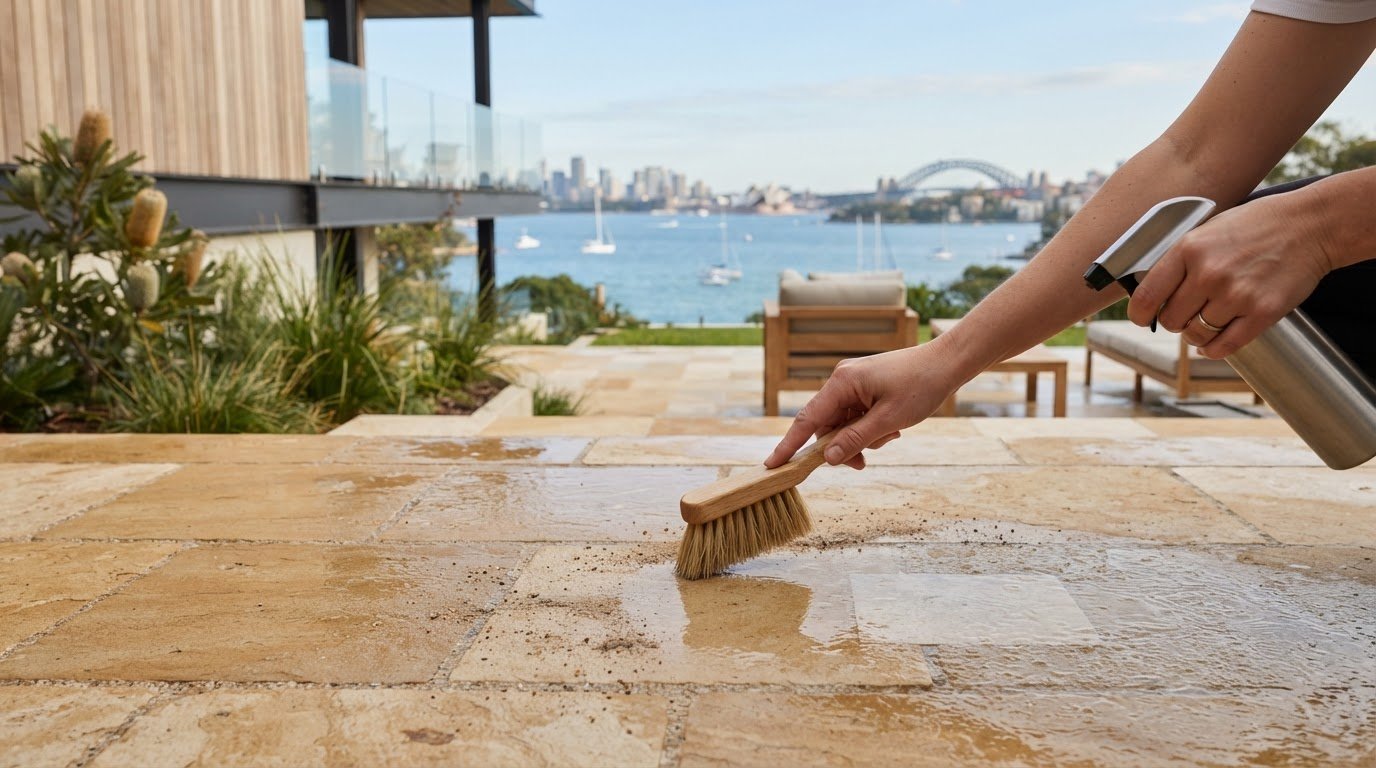
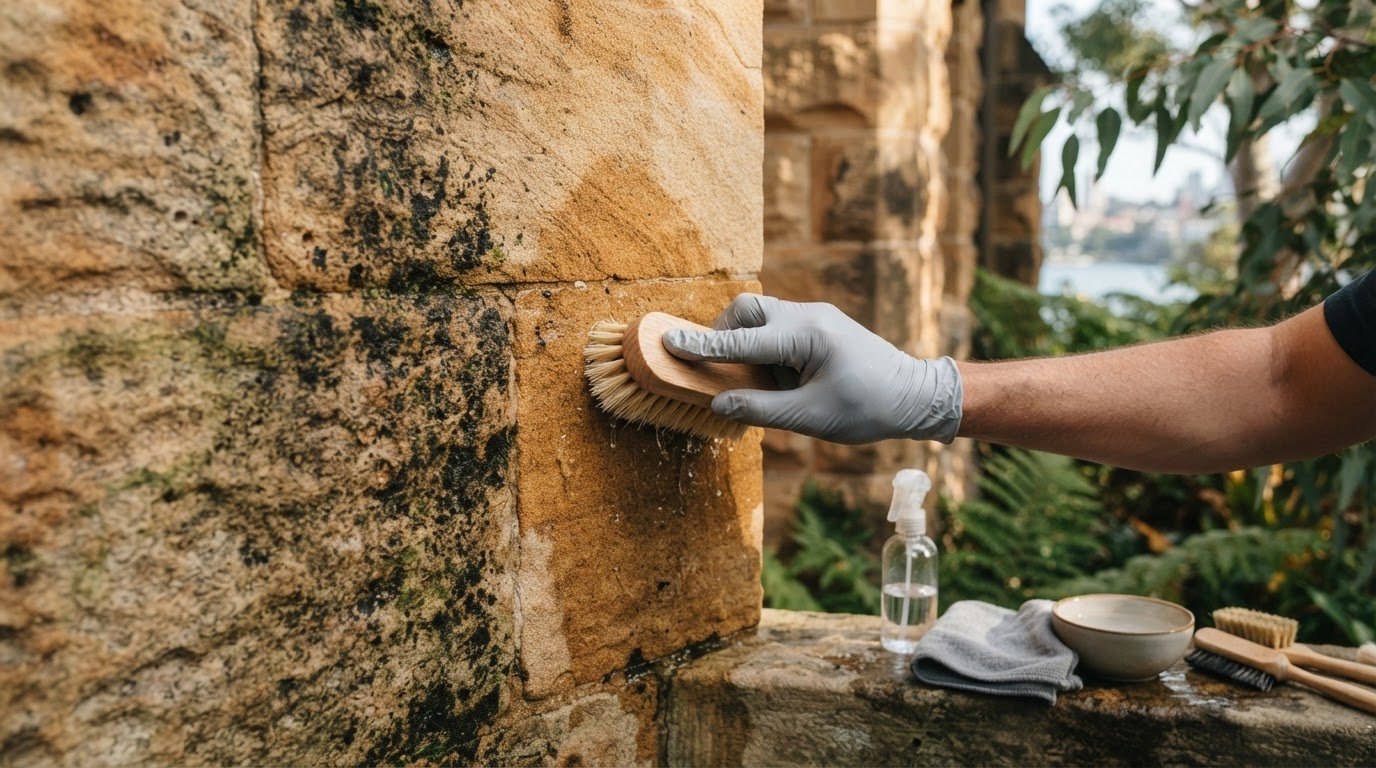
Two surfaces made from Tasmanian Sandstone can need different care, even when they look much the same. The stone’s character can vary, and its finish, condition and exposure all affect how it responds to cleaning. That is why broad claims about sandstone durability may not predict how a particular surface will behave.
If you’re caring for Tasmanian sandstone, start by identifying the surface and the type of mark before choosing a method. This guide covers the stone’s formation and place in Tasmania’s built history, explains how composition and exposure can affect weathering, and outlines a careful way to approach black spots and green algae. For an initial clean, water and a soft-bristle brush are gentler starting points than applying a strong cleaner without checking the surface.
Key Takeaways
- Sandstone grains and their natural binding material can differ between sources, so appearance alone does not tell you everything about a surface.
- Locally quarried stone became part of Tasmania’s built environment, with historical examples documented by the University of Tasmania.
- Tasmanian Sandstone can weather differently depending on its composition and exposure. Do not assume every surface will behave alike.
- Before treating black spots or green algae, identify the surface, read the product directions and test a discreet area.
What Is Tasmanian Sandstone? Understand Its Formation and Composition
Sandstone is sedimentary rock formed when sand-sized grains accumulate, become compacted and are cemented together over time. In Tasmanian Sandstone, as in sandstone from elsewhere, the grains and natural material binding them can vary. That mix affects the stone’s appearance and properties, so a general description cannot establish the exact composition of every Tasmanian source.
How sandstone forms from sand-sized grains
Sand and other particles settle in layers, often in water or other environments where sediment accumulates. As more layers collect, their weight presses the lower deposits together. Minerals carried by water can fill spaces between grains and bind them into rock, a process called cementation. The result is a naturally compacted mass, although deposits do not all form in precisely the same way. Quartz and feldspar are common sandstone minerals, but they are not present in every deposit.
Why Tasmanian sandstone can vary
Differences in mineral content, grain size, cement and the conditions in which sediment accumulated can produce variations in colour and banding. A supplier’s reported colour range may illustrate the diversity of its stone, but it is not a definitive range for all Tasmanian sandstone. The Geology of Tasmania overview provides context for the island’s varied geological history, not a composition report for every quarry. For a particular stone, use information tied to its source instead of assuming a general description applies.
This distinction matters when assessing stone for a building or planning its care. Two sandstone surfaces may look similar yet differ in grain structure or binding material. Identify the particular stone and assess its condition before deciding how it may respond to cleaning.
Tasmanian Sandstone in Buildings and Landscapes: A Local Material History
Stone from local quarries helped shape Tasmania’s built environment, connecting buildings with the geology around them. The University of Tasmania’s account of Tasmanian Sandstone in Building describes sandstone in public and private buildings and reports that small quarries were sometimes opened near construction sites. This linked the supply of building material with the place where it was needed.
From heritage stone to contemporary projects
Sandstone is used in more than historic buildings. As a general material, it can be used for walls, cladding and flooring. Its colour, texture and visible banding shape the look of a building or landscape. A subtle finish may suit one design, while more pronounced variation can become a feature.
Common applications include:
- Walls: Stone can bring texture and a natural appearance to outdoor or architectural walls.
- Cladding: A stone finish can add visual character to a building exterior.
- Flooring: Colour and surface texture influence the overall feel of an interior or outdoor area.
These are broad uses, not a guarantee that a particular stone is suitable for every project. Historic use shows sandstone’s place in the island’s building story, but does not establish its suitability for a new application. Intended use, stone dimensions, finish and site conditions all matter. Consider the technical requirements of the specific project as well as appearance.
If you’re considering Tasmanian Sandstone, use its visual character as a starting point, then assess the requirements of the intended use. For stone-care products for your Sydney property, get in touch with our team.
Tasmanian Sandstone Weathering: What Composition and Exposure Can Change
Sandstone is not uniformly durable or equally resistant to weather. Its response depends partly on the stone and partly on the conditions it faces. A sheltered wall and an exposed surface may weather differently, even if they came from the same source. Weathering is gradual change, not proof that stone has failed or will inevitably need intensive maintenance.
Why some Tasmanian sandstone may weather differently
The University of Tasmania notes that many Tasmanian sandstones contain clay minerals, including smectite, illite and kaolinite, and may weather poorly. This is an observation about many examples, not a prediction for every block or building. Clay minerals can influence how stone responds to its environment, but their presence alone does not establish the condition, strength or maintenance needs of a particular surface.
Rain, wind, shade and prolonged dampness can affect exposed stone and encourage surface soiling or organic growth. Existing wear, repairs and the stone’s composition matter too. The same cleaning method may not suit every surface, so avoid treating general descriptions of sandstone as a guarantee of performance. The University of Tasmania’s building-stone history provides context for its weathering note.
What to observe before planning stone care
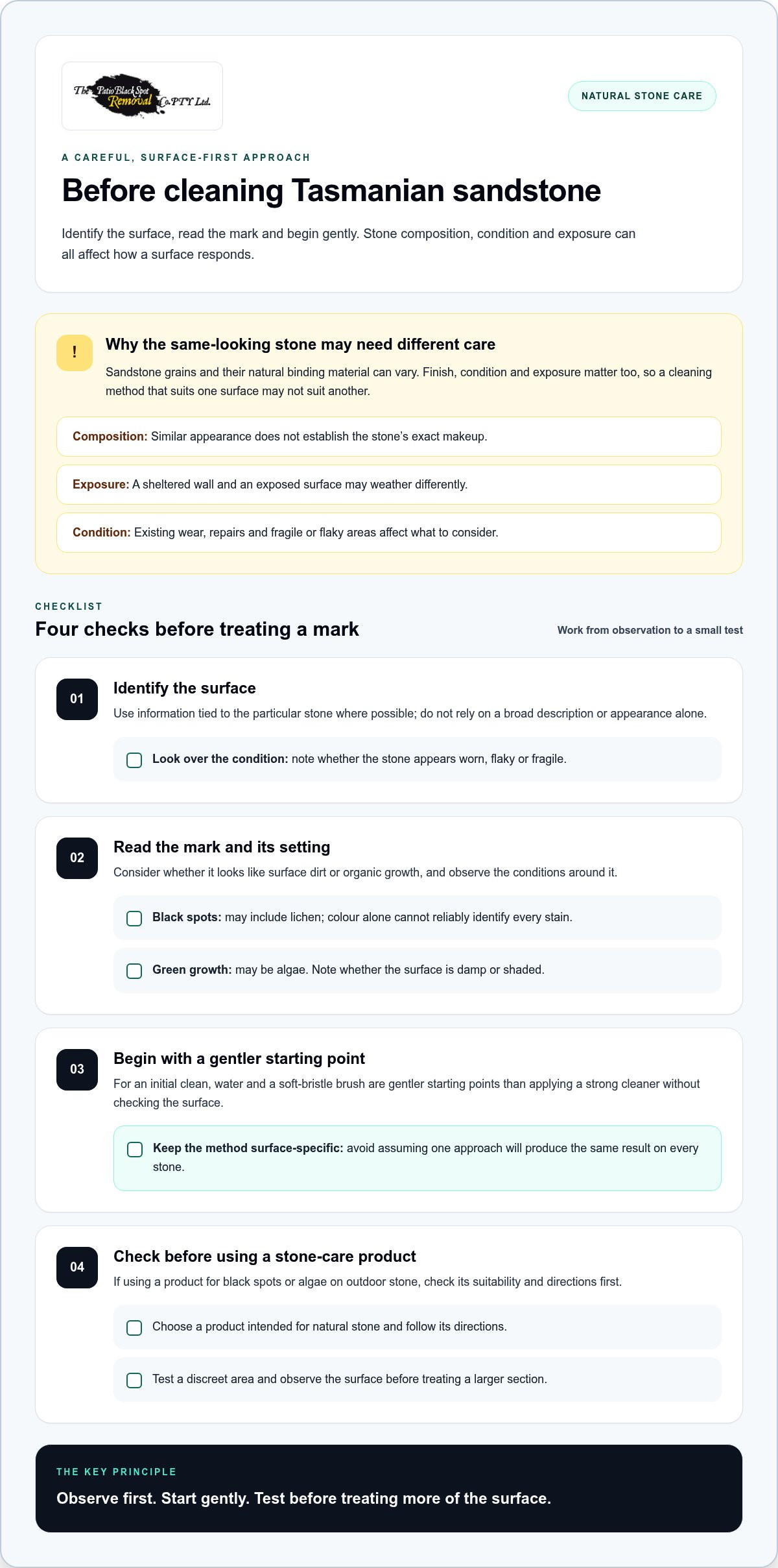
Start with the visible condition. Note whether the mark looks like surface dirt or organic growth, whether the stone is damp or shaded, and whether it appears worn, flaky or fragile. Identify the stone as closely as possible, then assess a small, inconspicuous area before treating a larger section. This staged approach lets you observe the surface before proceeding.
For a careful next step with black spots or algae on an outdoor stone surface, choose a product intended for natural stone and follow its directions.
Cleaning Black Spots on Tasmanian Sandstone: A Careful, Surface-First Approach
Black spots and green algae can be signs of organic growth on an outdoor surface, but they do not identify the stone. Dark marks may include lichen and green growth may be algae, yet colour alone cannot reliably identify every stain. When cleaning Tasmanian Sandstone, consider the surface’s condition before choosing a method. Avoid aggressive treatment and do not assume one approach will produce the same result on every stone.
A cautious approach to black spots and algae
Work through these steps before applying a cleaner:
- Identify the surface. Note the stone type if known, its finish and any signs of wear or fragility.
- Read the product directions. Check that they support use on the specific surface rather than relying on a broad assumption about natural stone.
- Test discreetly. Apply as directed to a small, inconspicuous area and observe the surface.
- Follow the instructions. Use the product only as directed, and stop if the test area shows an unwanted change.
Patio Black Spot Remover is formulated for natural stone and removes stubborn black lichen spots. The treatment is designed to restore the stone’s natural colour in under two hours.
Preventing organic growth from returning
After cleaning, ongoing care still matters. Patio Black Spot Preventer is designed for annual application to help prevent organic growth from returning and kill green algae without pressure washing. It is not a substitute for routine observation, especially where a surface stays damp or shaded. Follow the product directions for the stone and application, rather than assuming one treatment removes every future cleaning need.
For a natural stone patio or other outdoor stone surface, explore our stone-cleaning products and choose the one suited to the task.
Choose a Thoughtful Next Step for Your Stone
Let the surface’s condition guide your next move. Before treating a mark, consider what you’re seeing and what the stone needs instead of reaching for the strongest approach. This helps you care for Tasmanian Sandstone with more confidence and avoid assuming every surface calls for the same treatment.
If a targeted cleaner may be appropriate, use its directions to guide your decision and test discreetly before treating a larger area. Our specialist stone-cleaning products are manufactured in Sydney, use biodegradable, acid-free formulations and are delivered across Australia. Patio Black Spot Remover is designed to remove stubborn black lichen spots and restore the natural colour of stone in under two hours. Always follow the product directions for the surface you’re treating.
For your Sydney stone-cleaning needs, get in touch with our team or explore Patio Black Spot Remover and Patio Black Spot Preventer to choose a product for cleaning or ongoing care.
Frequently Asked Questions
How can I tell whether a stone is sandstone?
A grainy, sand-like texture can be a clue, but it cannot confirm the stone’s identity on its own. Look at an existing exposed edge and check building records, invoices or stone documentation for a reliable description. Colour and texture can help form an initial impression, but other materials may look similar. If identification will guide a significant cleaning or building decision, use information about the stone’s source.
Is Tasmanian sandstone suitable for outdoor use?
It can be suitable for some outdoor applications, but there is no blanket answer for every stone or project. Consider where it will be installed, what it will be used for and the conditions it will face. Paving and decorative walling, for example, have different functional demands. Use documentation for the specific stone and compare it with the requirements of your intended application instead of relying on the name “sandstone” alone.
Does Tasmanian sandstone need to be sealed?
Not necessarily. Whether sealing is appropriate depends on the stone, its use and any existing treatment. Before applying a sealer, check that its directions cover the particular stone and finish, and follow the stone supplier’s care guidance where available. Do not treat sealing as a substitute for ordinary upkeep or as a guarantee against marks and weathering. If the surface has already been sealed, factor that into any cleaning decision.
Can I use a household cleaner on Tasmanian sandstone?
Only use one if its directions state that it is suitable for the stone surface. A cleaner that works on a benchtop or ceramic tile may not be appropriate for sandstone. For a Sydney patio with dark spots, first consider whether the marks could be organic growth, then choose a product intended for natural stone and follow its label. Avoid combining cleaners or applying them more broadly than directed.
Is Tasmanian sandstone the same as sandstone from other parts of Australia?
No. Sandstone describes a broad rock type, not a uniform material with identical characteristics everywhere. Grain size, mineral content and appearance can differ between geological sources, so Tasmanian Sandstone should not automatically be treated as equivalent to stone from another Australian region. If you’re matching new stone to an existing feature, compare source details and samples rather than relying on a general label or photograph.