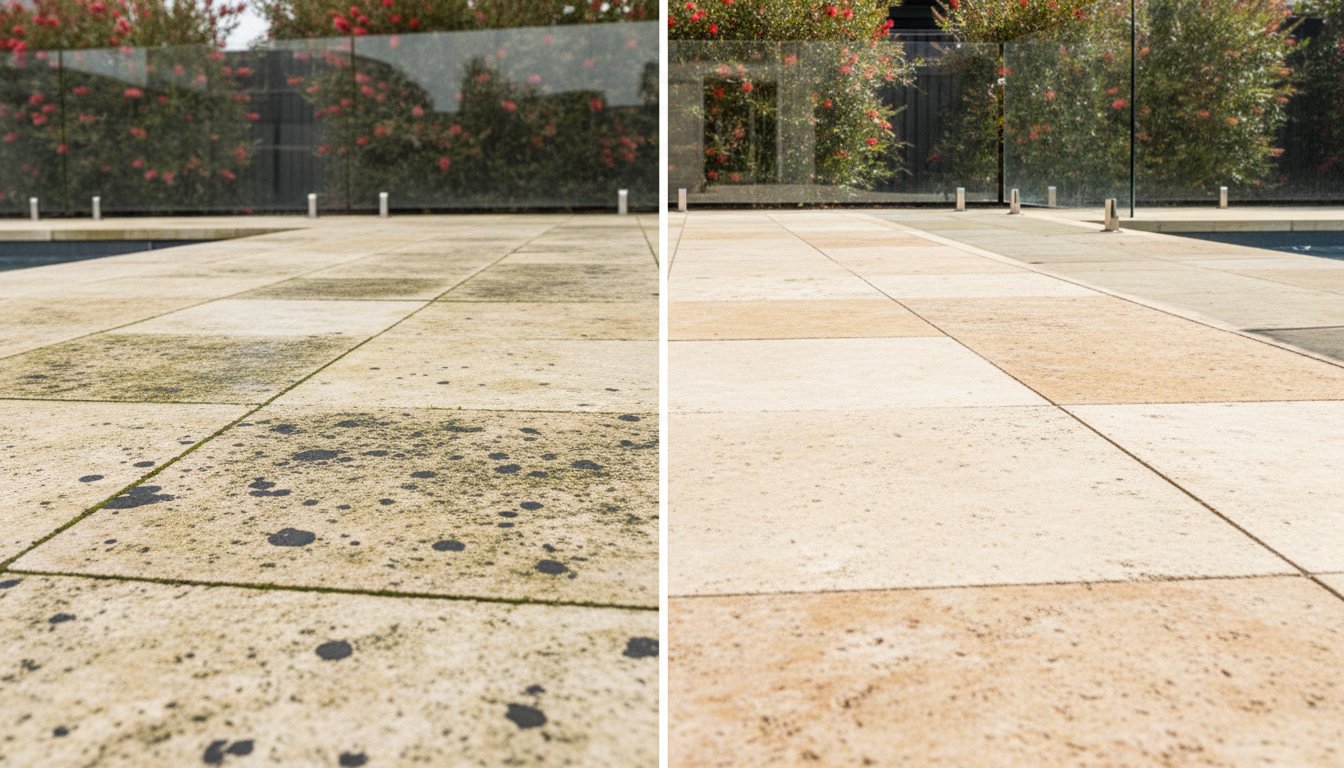
If you've spent hours pressure washing your patio only to find it turning green again a few weeks later, you're probably wondering, "Why does my patio keep going green?" Green algae and other organic growth can be difficult to keep under control, particularly on porous natural stone.. You're likely tired of dealing with slippery, dangerous surfaces and an ugly film that ruins your home's aesthetic, all while fearing that aggressive cleaning might permanently damage your expensive natural stone.
The truth is that you aren't just dealing with surface dirt. Your patio is actually "infected" at a microscopic level by spores that thrive deep within the pores of the material. This article will show you how to move past temporary fixes and implement a total biological reset. We'll explore the professional-grade strategies used here in Sydney to eliminate algae and prevent its return for up to 12 months. You'll learn why treating the root system is the only way to ensure a safe, non-slip outdoor area that stays clean for years rather than weeks.
Key Takeaways
- Understand that the green film on your stone is a living organism with "roots" called rhizoids that anchor themselves deep inside microscopic pores.
- Stop wondering why "my patio keeps going green" by learning how traditional pressure washing can actually accelerate regrowth by opening the stone's surface.
- Discover the specialized two-step framework designed to kill the biological root system and provide a residual shield that lasts up to 12 months.
- Identify the critical difference between generic concrete cleaning and the specialized care required for natural stone to avoid permanent damage.
- Master a low-effort annual maintenance calendar tailored for Sydney's climate to keep your outdoor areas safe and non-slip year-round.
The Science of the Green: Why Your Patio Keeps Changing Colour
Many homeowners assume the discoloration on their pavers is just dirt or a mineral stain. However, if you find yourself saying "my patio keeps going green," you're actually witnessing a biological colonization. Green algae is a living organism that treats your stone surface like a fertile field. Understanding the science of the green is the first step in stopping the cycle, as these organisms don't just sit on the surface; they actively interact with the stone's chemistry. Unlike a simple layer of dust, algae grows, breathes, and reproduces, making it a persistent enemy for any outdoor space.
For algae to thrive, it requires three things: consistent moisture, lack of direct sunlight, and a supply of organic matter like leaf litter or dust. Microscopic spores travel through the air on the slightest breeze, landing on your paving and waiting for the right conditions to germinate. In the humid Sydney climate of 2026, we've seen specific weather patterns with higher-than-average dew points and late-season rains that create a perfect incubator for these spores. Unlike the dry winters of previous decades, current patterns keep the stone damp for longer periods, allowing algae to remain active rather than going dormant.
Algae vs. Lichen vs. Moss: Know Your Enemy
Identifying exactly what's growing on your stone is vital for choosing the right treatment. Algae typically appears as a slippery green film that covers large areas quickly, especially after a period of rain. Lichen, on the other hand, presents as crusty white or black spots that seem almost "cemented" to the surface and won't budge with a standard hose. While algae is often a surface-level nuisance, moss usually indicates a deeper drainage issue where water sits stagnant in the joints. Mould often joins the party in the darkest, dampest corners, appearing as fuzzy grey or black patches that can be particularly stubborn to remove without professional intervention.
The Role of Micro-Climates in Your Backyard
Different parts of the same garden can have very different conditions.
Patios that receive little direct sunlight may stay damp for longer, making them more likely to develop algae. Areas underneath trees, beside fences or close to garden beds can have similar issues.
Blocked or overflowing gutters can also send water and organic debris onto paving. If water repeatedly collects in the same area, it can create conditions where green growth develops much more quickly.
The Porosity Trap: Why Algae Lives Deep Inside the Stone
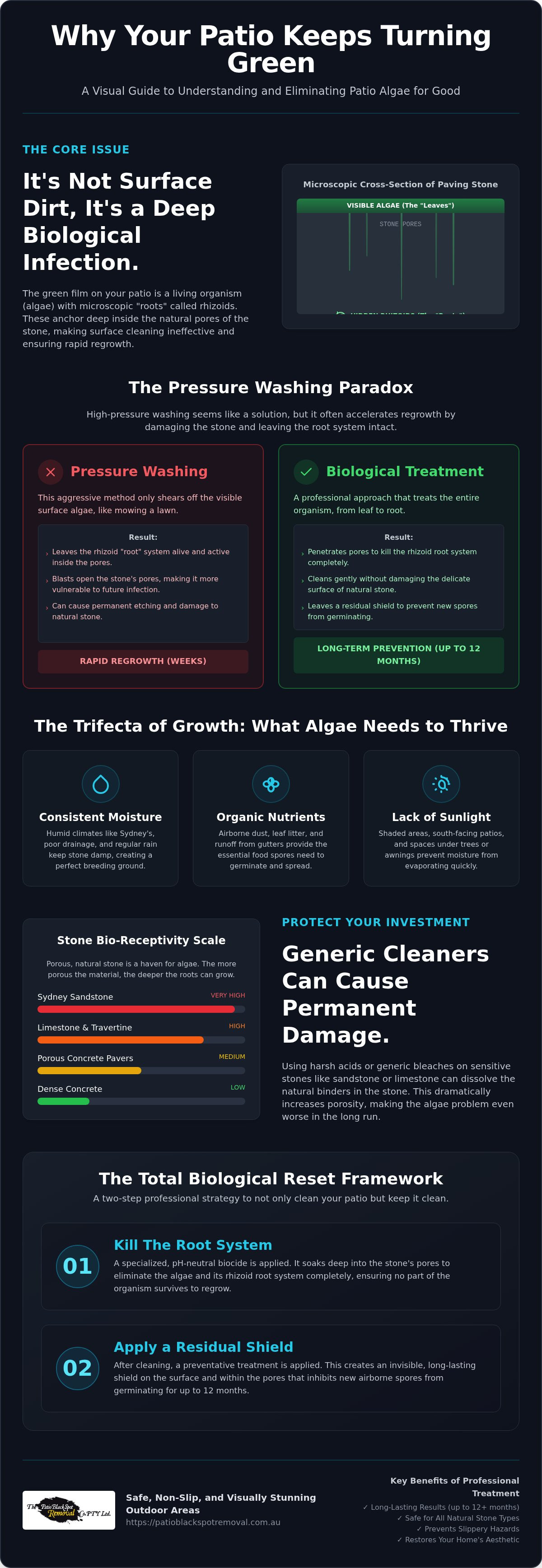
If you've ever spent a weekend scrubbing your pavers only to find yourself saying "my patio keeps going green" just a few weeks later, you're likely a victim of the porosity trap. Natural stone isn't the solid, impenetrable block it appears to be. Under a microscope, materials like sandstone or limestone resemble a hard sponge, with lots of tiny, interconnected pores. While you can see the green film on top, the real problem is happening out of sight. Algae uses microscopic "roots" called rhizoids to anchor itself deep within these pores, shielding the organism from the sun and wind.
Generic surface cleaning is often ineffective because it only removes the "leaves" of the algae while leaving the root system completely intact. Scientific research into algae on paving confirms that porous surfaces provide a protected environment that encourages rapid recolonization. When you wash away the surface layer, you're essentially "mowing the lawn" for the algae. Within days, the surviving rhizoids use the newly available moisture to push back to the surface, creating a cycle of growth that feels impossible to break without treating the stone's internal structure.
Sandstone, Travertine, and Limestone: A Biological Haven
Not all stone is created equal when it's a matter of "bio-receptivity." Sydney Sandstone, while beautiful, is incredibly porous and sits at the top of the list for algae vulnerability. Limestone and Travertine follow closely behind. Paradoxically, the high-quality natural stone you've invested in is often more prone to going green than cheap, dense concrete. You must be careful with your choice of cleaner; using generic acids or harsh supermarket bleaches on these sensitive Australian stone types can eat away at the calcium carbonate in the stone, making the pores even larger and the problem worse. You can learn more about how this biological process works and how to stop it correctly.
How Water Tension Keeps the Pores Damp
Even when the surface of your patio appears dry, moisture can remain within the pores of porous stone. This is partly due to capillary action, where water moves through small spaces within the material. Shaded areas can therefore remain damp for longer than they appear from the surface. That additional moisture can contribute to recurring algae growth, particularly when combined with limited sunlight and poor drainage.
If you're struggling to manage this cycle, it might be time to speak with an expert about deep-pore treatment.
Why Pressure Washing Often Makes the Problem Worse
The standard reaction to a slippery, discolored outdoor area is to reach for the pressure washer. It's an satisfying process that provides instant gratification. However, this approach is often the primary reason homeowners find themselves frustrated, claiming "my patio keeps going green" sooner every year. While the high-pressure stream removes the visible film, it lacks the biological capability to kill the organism. Instead of solving the issue, you're often just accelerating the next growth cycle through the "blasting effect."
High-pressure water acts as a delivery system for microscopic spores. As you move the wand across the stone, the force pushes these spores deeper into the pores we discussed previously. You're essentially "planting" the algae in a protected, damp environment where sunlight can't reach but moisture remains trapped. This physical force also strips away jointing sand between your pavers. Removing this sand doesn't just destabilize the surface; it creates large, debris-filled gaps that invite weeds and further moisture retention, creating an even more hospitable environment for biological colonization.
Mechanical Damage to Natural Stone
Natural stone is far more delicate than most people realize. Pressure washing at high PSI can leave the surface permanently damaged. This erosion creates a rougher texture at a microscopic level. While you can't see it with the naked eye, this new roughness provides algae with significantly more "grip" to anchor its rhizoids. Softer stones like Sydney Sandstone are particularly vulnerable to this etching. Once the surface is compromised, the stone becomes even more bio-receptive, meaning it will turn green faster and hold onto stains more tenaciously than before it was cleaned.
The Illusion of Cleanliness
A patio can look completely different immediately after pressure washing. The visible green film has gone, but that doesn't necessarily mean the conditions that caused it have changed. If the area remains shaded, damp or surrounded by organic debris, algae can gradually return.
This is why some homeowners find themselves cleaning the same patio repeatedly throughout the year. Instead of relying entirely on mechanical cleaning, it can be useful to combine suitable cleaning with preventative treatment.
To break this cycle, you need to move away from mechanical force and toward targeted biological removal.
The Sydney Solution: Effective Removal and Long-Term Prevention
To break the cycle of "my patio keeps going green," you need a strategy that addresses the biological infection at its source. Sydney's specific combination of high humidity and porous sandstone makes generic supermarket cleaners or "spray and leave" products ineffective. The professional-grade solution is a two-step framework that first sanitizes the stone and then establishes a long-term defense. This method moves beyond surface cleaning to restore the stone's original beauty while protecting its structural integrity. You can learn more about how it works to restore your stone and stop the cycle of regrowth.
Timing your treatment with Sydney's seasonal changes is also helpful. The high-growth periods typically follow our humid summer months and late-season rains. By applying a professional treatment before these peaks, you can neutralize spores before they have the chance to colonize the stone's internal structure. This proactive approach is far more effective than waiting for the surface to become a slippery hazard.
Step 1: Deep Pore Sanitization
Using a targeted remover for natural stone is the essential first step. Unlike the mechanical "blasting" of a pressure washer, which we've already identified as a cause of surface damage, this specialized formula works through biocidal action. It dissolves the organic bond between the algae and the stone, effectively "lifting" the biological matter out of the microscopic pores without the need for abrasion. This chemical process is superior because it kills the root system entirely, ensuring that the stone is truly sanitized rather than just visually cleared.
Step 2: Creating a Hostile Environment for Spores
Once the stone is clear of the existing infection, you must create a hostile environment for any new spores that land on the surface. Introducing a preventer for all stone types provides a residual shield that can last up to 12 months. These treatments work by maintaining a surface environment that discourages biological growth and prevents airborne spores from germinating. By keeping the stone's pH at a level that algae cannot tolerate, you ensure that your entertaining area remains a safe, non-slip environment year-round.
Ongoing Maintenance: Keeping Your Patio Green-Free Year-Round
Once you've cleaned your patio, a small amount of regular maintenance can help prevent the same problem from building up again.
Leaves, grass clippings and other organic debris can hold moisture against the stone, while poor drainage can keep parts of the patio damp for longer.
A low-effort maintenance calendar for Sydney homeowners looks like this:
- Autumn: Clear fallen leaves and organic debris weekly to remove algae food sources.
- Winter: Inspect all drainage points and ensure water isn't pooling on the stone surface.
- Spring: Apply your annual top-up of the preventer for all stone types to prepare for humid months.
- Summer: Monitor shaded areas for a faint green haze, especially after heavy afternoon storms.
Garden Hygiene and Drainage
Leaves, twigs, and grass clippings are essentially fuel for biological growth. When organic matter sits on damp stone, it breaks down and creates a nutrient-rich layer that invites algae to colonize. Ensure your deck drains and patio runoff points remain clear of debris to prevent standing water. If your garden beds use mulch, be mindful of heavy rain washing soil onto your pavers, as this introduces high levels of nitrogen that accelerate the green tint. Keeping the perimeter of your patio clear ensures that moisture can evaporate quickly, denying algae the moisture it needs to survive.
The 12-Month Prevention Rule
The most effective way to keep your natural stone looking its best is annual prevention. Re-applying a preventer for all stone types every 12 months maintains the hostile environment that stops spores from germinating. This top-up treatment is significantly faster and easier than a full deep clean because you're simply reinforcing the existing shield within the stone's pores. Consistent prevention costs 80% less than corrective restoration over a five-year period. By acting before the "first blush" of green appears, you protect your investment and ensure your Sydney home is always ready for entertaining. If you notice a faint green haze starting to form in shaded corners, don't wait for it to become a slip hazard; a quick maintenance application will stop the infection in its tracks.
Take Control of Your Stone's Longevity
Understanding that algae is a living organism rather than a simple stain changes how you approach your outdoor maintenance. You now know that high-pressure washing often does more harm than good by damaging the stone's face and pushing spores deeper into the pores. If you've been stuck in a cycle where "my patio keeps going green," the shift from mechanical scrubbing to biological sanitization is the only way to see lasting results. By treating the root system and applying annual protection, you can enjoy a safe, non-slip surface that stays clean for years.
Our specialist formulas are specifically designed for the unique challenges of Sydney Sandstone and are trusted by professional landscapers across Australia. We provide residual protection that stops regrowth for up to 12 months, ensuring your investment remains beautiful and safe for your family. Don't let a green film ruin your weekend or your property's value. Restore your patio's natural beauty with our professional Natural Stone Remover and start your journey toward a maintenance-free outdoor area today. Your patio deserves professional care that actually lasts.
Frequently Asked Questions
Is the green stuff on my patio dangerous or just ugly?
Green algae is both a significant safety hazard and an aesthetic problem. When wet, the film becomes incredibly slippery, which increases the risk of falls for your family and guests. Beyond the immediate danger, these organisms produce organic acids that can slowly degrade the surface of your stone over time. Treating the issue early prevents permanent pitting and ensures your entertaining area remains a safe environment.
Can I use household bleach or vinegar to kill the green algae?
You should avoid using household bleach or vinegar on natural stone surfaces. Vinegar is highly acidic and can etch or permanently scar sensitive stones like limestone and sandstone. While bleach might kill surface growth, it often contains salts that lead to efflorescence, leaving behind a white powdery deposit. Professional formulas are pH-balanced to protect the stone's structural integrity while killing the spores deep within the pores.
Why did my patio go green so much faster this year than last year?
Increased humidity and specific rainfall patterns in Sydney often explain why "my patio keeps going green" faster than in previous seasons. If the stone doesn't have enough time to dry out completely between rain events, the internal pores remain saturated. This creates a constant nursery for airborne spores to germinate. Current weather trends with higher dew points provide the perfect incubator for rapid biological colonization across your pavers.
Is it safe to use patio cleaners around my lawn and pets?
Professional patio treatments are generally safe for pets and lawns once the surface has completely dried. You should keep animals away during the application process and until the stone is no longer wet to the touch. If you're concerned about runoff into nearby garden beds, rinsing the surrounding grass with fresh water before and after the application helps protect sensitive plants from any accidental overspray.
How long does a professional patio treatment actually last?
A professional preventer treatment typically provides a residual shield that lasts up to 12 months. While the initial deep cleanse removes the existing biological infection, the secondary preventer stage stops new spores from taking root. This 12 month window assumes you maintain basic garden hygiene, such as clearing away wet leaves and ensuring your patio's drainage points remain clear of debris.
Do I need to scrub the patio after applying a professional remover?
You don't need to perform heavy scrubbing when using a professional-grade remover. The formula is designed to dissolve the organic bond and lift the algae out of the pores through biocidal action rather than mechanical force. After the product has had the required time to work, a light rinse with a garden hose is usually enough to wash away the dead biological matter.
Will the green algae come back if my patio is always in the shade?
Algae is significantly more likely to return in shaded areas because these spots lack the natural disinfecting power of UV light. Sunlight acts as a drying agent; without it, the stone stays damp for much longer periods. This constant moisture is exactly what spores need to thrive, making regular application of a preventer even more critical for south-facing patios or areas under heavy tree canopies.
Can I use these products on porcelain tiles or just natural stone?
These treatments are effective on both porcelain tiles and natural stone. While porcelain is less porous and doesn't suffer from the same deep-root infections as sandstone, it still develops a slippery surface film in damp conditions. Using a specialized cleaner ensures you remove the biological growth without leaving behind a sticky residue that could attract more dirt and spores over time.